
Hidradenitis Suppurativa · United Kingdom
AI representation changes with the question.
Four AI systems answered 1,143 questions about hidradenitis suppurativa, asked in English from a UK dermatologist's perspective and spread across five areas of the treatment conversation. Which treatments they name depends on the area.
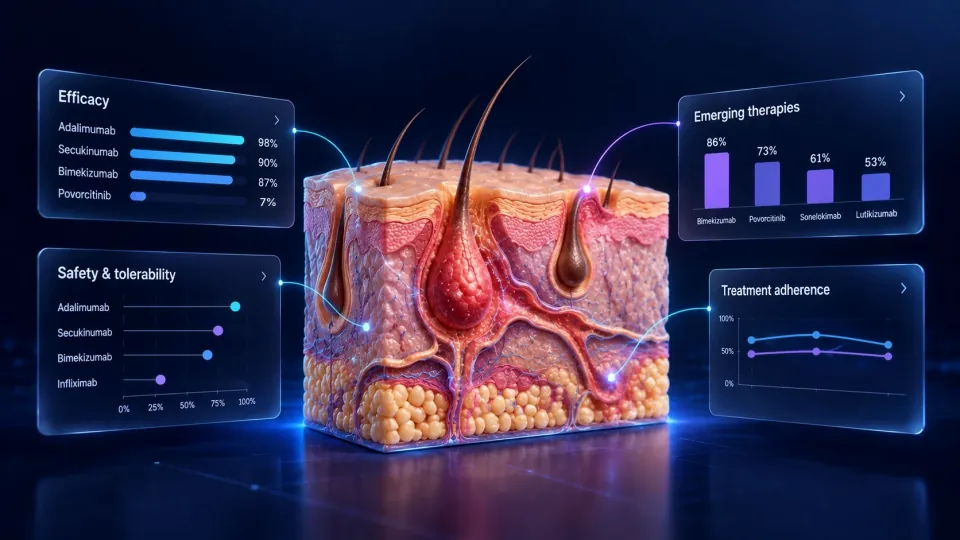
Adalimumab is the most often named molecule overall, in 89% of all answers. In answers about emerging therapies it is named in 50% — and bimekizumab in 86%.
- stakeholder
- Dermatologists
- language
- English
- questions
- 1,143
- responses
- 4,572
- AI systems
- 4
- question areas
- 5
- measured
- September 2026
01 · AI Representation Map
Different questions, different representation.
The overall figure counts every question together. Split the same answers by what was asked, and a molecule named in most answers about one area can be almost absent from another.
AI Visibility % by question area
% of answers that name the molecule at least once. Select a question area to see how often each molecule is named in answers about it.
N = 4,572 responses from four AI systems · each area's base is shown with it
All questions· n = 4,572 responses
Efficacy· n = 1,704 responsesall questions
Safety & tolerability· n = 1,152 responsesall questions
Convenience· n = 960 responsesall questions
Treatment adherence· n = 180 responsesall questions
Emerging therapies· n = 576 responsesall questions
| All questionsn = 4,572 | Efficacyn = 1,704 | Safety & tolerabilityn = 1,152 | Conveniencen = 960 | Treatment adherencen = 180 | Emerging therapiesn = 576 | |
|---|---|---|---|---|---|---|
| Select a molecule for its profile | ||||||
| Named across the conversationIn at least half of the answers in every question area. | ||||||
| Adalimumab | 89% | 98% | 90% | 95% | 97% | 50% |
| Secukinumab | 81% | 90% | 76% | 80% | 75% | 72% |
| Bimekizumab | 76% | 87% | 67% | 65% | 53% | 86% |
| Named in some areas more than othersBelow half in at least one area, and named mostly outside emerging-therapy questions. | ||||||
| Clindamycin | 39% | 42% | 42% | 54% | 33% | <1% |
| Infliximab | 34% | 43% | 29% | 38% | 44% | 2% |
| Rifampicin | 21% | 23% | 27% | 25% | 23% | 0% |
| Doxycycline | 13% | 7% | 12% | 33% | 4% | 0% |
| Ertapenem | 8% | 10% | 6% | 12% | 2% | <1% |
| Minocycline | 7% | 3% | 6% | 21% | 2% | 0% |
| Acitretin | 6% | 4% | 7% | 10% | 6% | 0% |
| Spironolactone | 6% | 5% | 3% | 13% | 2% | <1% |
| Anakinra | 5% | 8% | 4% | 1% | 1% | 5% |
| Tetracycline* | 4% | 2% | 4% | 10% | 3% | <1% |
| Dapsone | 4% | 2% | 5% | 8% | 3% | 0% |
| Metformin | 3% | 2% | 3% | 6% | 1% | <1% |
| Colchicine | <1% | <1% | 1% | <1% | 0% | 0% |
| Named mostly about emerging therapiesMost of the answers that name it are answers to emerging-therapy questions. | ||||||
| Povorcitinib | 13% | 7% | 4% | 2% | 2% | 73% |
| Sonelokimab | 11% | 6% | 3% | 0% | 3% | 61% |
| Upadacitinib | 10% | 6% | 3% | 2% | 3% | 50% |
| Lutikizumab | 9% | 5% | 2% | 0% | 2% | 53% |
| Spesolimab | 8% | 3% | 2% | <1% | 0% | 50% |
| Remibrutinib | 5% | <1% | <1% | 0% | 0% | 40% |
| Izokibep | 2% | 1% | <1% | <1% | 0% | 15% |
| Brivekimig | 1% | <1% | 0% | 0% | 0% | 9% |
| Tibulizumab | <1% | 0% | 0% | 0% | 0% | 7% |
| Abdakibart | <1% | <1% | <1% | <1% | 0% | 3% |
| Tulisokibart | <1% | 0% | <1% | 0% | 0% | <1% |
| Zasocitinib | <1% | 0% | <1% | 0% | 0% | <1% |
Showing the 13 molecules named in at least 25% of answers in at least one question area.
* Includes answers that refer to tetracyclines as a class.
02 · The overall ranking
Three molecules are named in most answers. The overall ranking hides where representation changes.
Adalimumab, secukinumab and bimekizumab are each named in at least 76% of all answers; the next, clindamycin, in 39%. Share of Voice counts mentions rather than answers, so it also reflects how often a molecule is named within the answers that include it.
| Rank | Molecule | AI Visibilityanswers naming it | Share of Voiceof all molecule mentions |
|---|---|---|---|
| 11 | Adalimumab | 89.2%4,059 / 4,549 | 26.6%10,442 mentions |
| 23 | Secukinumab | 81.3%3,708 / 4,562 | 19.1%7,511 mentions |
| 32 | Bimekizumab | 76.0%3,459 / 4,553 | 20.0%7,868 mentions |
| 45 | Clindamycin | 38.7%1,766 / 4,566 | 6.2%2,454 mentions |
| 54 | Infliximab | 33.6%1,532 / 4,566 | 6.4%2,496 mentions |
| 66 | Rifampicin | 21.4%977 / 4,569 | 3.3%1,301 mentions |
| 77 | Povorcitinib | 13.4%611 / 4,571 | 2.3%915 mentions |
| 88 | Doxycycline | 12.5%573 / 4,570 | 2.0%793 mentions |
| 99 | Sonelokimab | 10.6%484 / 4,571 | 2.0%792 mentions |
| 1010 | Upadacitinib | 9.5%435 / 4,571 | 1.5%581 mentions |
| 1111 | Lutikizumab | 9.3%425 / 4,572 | 1.4%565 mentions |
| 1212 | Ertapenem | 8.1%369 / 4,572 | 1.2%491 mentions |
| 1313 | Spesolimab | 7.7%353 / 4,572 | 1.2%476 mentions |
| 1414 | Minocycline | 7.1%324 / 4,572 | 1.2%452 mentions |
| 1515 | Acitretin | 5.8%266 / 4,572 | 0.9%350 mentions |
| 1617 | Spironolactone | 5.7%261 / 4,572 | 0.8%308 mentions |
| 1716 | Remibrutinib | 5.4%246 / 4,572 | 0.8%318 mentions |
| 1818 | Anakinra | 5.1%233 / 4,572 | 0.7%264 mentions |
| 1920 | Tetracycline | 3.8%176 / 4,572 | 0.5%205 mentions |
| 2019 | Dapsone | 3.8%172 / 4,571 | 0.6%226 mentions |
| 2121 | Metformin | 2.7%123 / 4,571 | 0.4%151 mentions |
| 2222 | Izokibep | 2.4%110 / 4,572 | 0.4%145 mentions |
| 2323 | Brivekimig | 1.3%58 / 4,572 | 0.2%77 mentions |
| 2424 | Tibulizumab | 0.9%39 / 4,572 | 0.1%45 mentions |
| 2525 | Abdakibart | 0.6%27 / 4,572 | 0.1%32 mentions |
| 2626 | Colchicine | 0.4%17 / 4,571 | 0.1%27 mentions |
| 2727 | Tulisokibart | 0.1%4 / 4,572 | 0.0%4 mentions |
| 2727 | Zasocitinib | 0.1%4 / 4,572 | 0.0%4 mentions |
Secukinumab is named in more answers than bimekizumab (81.3% against 76.0%); bimekizumab has the larger Share of Voice (20.0% against 19.1%), with 2.27 mentions per answer that names it against 2.03. Reach and depth are different measures. Neither is a preference.
03 · Where representation changes
The same molecules, a different picture.
When the question is about emerging therapies
Adalimumab is the most often named molecule overall. In answers about emerging therapies it is named in 50% and moves to position 6; bimekizumab is named in 86%, and povorcitinib — 13% overall — in 73%.
- All questions
- Emerging-therapy questions
- Bimekizumab76% → 86%#3 → #1
- Povorcitinib13% → 73%#7 → #2
- Secukinumab81% → 72%#2 → #3
- Sonelokimab11% → 61%#9 → #4
- Lutikizumab9% → 53%#11 → #5
- Adalimumab89% → 50%#1 → #6
- Upadacitinib10% → 50%#10 → #7
- Spesolimab8% → 50%#13 → #8
- Remibrutinib5% → 40%#17 → #9
- Infliximab34% → 2%#5 → #15
- Clindamycin39% → <1%#4 → #19
Position is the order of molecules by how often they are named — a frequency, not a preference or a recommendation. Shown: every molecule named in at least a quarter of answers, overall or about emerging therapies (576 answers).
Similar reach overall, different profiles by area
Named at almost the same rate in answers about efficacy, the two separate elsewhere: secukinumab is named more often in answers about convenience and treatment adherence (the smallest area, 180 answers), bimekizumab in answers about emerging therapies.
- Secukinumab
- Bimekizumab
- All questions81% · 76%
- Efficacy90% · 87%
- Safety & tolerability76% · 67%
- Convenience80% · 65%
- Treatment adherence75% · 53%
- Emerging therapies72% · 86%
An overall figure averages over whatever was asked. Which part of the conversation matters is a question for each brand.
04 · Different AI systems, different treatment landscapes
The AI system being asked changes the treatment landscape.
Outside the questions about emerging therapies, Perplexity and Gemini name at least one tracked antibiotic in most of their answers; Claude and ChatGPT in about one in five.
- Claude18%184 of 998 answers
- ChatGPT22%220 of 999 answers
- Gemini70%700 of 999 answers
- Perplexity78%783 of 999 answers
Tracked antibiotics: clindamycin, doxycycline, ertapenem, minocycline, rifampicin and tetracycline. The 576 answers about emerging therapies are left out, because those questions concern therapies in development.
Each tracked antibiotic, by AI system — all questions
- Claude
- ChatGPT
- Perplexity
- Gemini
- Clindamycin15–63%
- Rifampicin2–51%
- Doxycycline3–25%
- Ertapenem1–20%
- Minocycline2–19%
- Tetracycline1–10%
Rifampicin is named in 1.7% of ChatGPT's answers and 51.5% of Gemini's. Tetracycline includes answers that refer to tetracyclines as a class.
Different systems can represent the same treatment landscape very differently. Visibility shows the difference; it does not show which system is right.
Beyond Visibility
Visibility tells you where you are named. AI Representation tells you what is said when you are.
This benchmark shows which molecules AI names, and how that changes with the question and with the system asked. Being named is a hygiene factor, not a differentiator. What matters is how AI models describe your products when they are named — and whether that description aligns with your business objectives and strategic priorities.
This is where Theralexis comes in. Our experts are experienced pharma commercial leaders who help pharma marketing and omnichannel teams identify and focus on the biggest commercial opportunities. We use an AI Representation assessment as the starting point, then provide channel and content recommendations to strengthen how your products are represented across AI.
Your market
See how AI represents your therapy in the questions that matter to your brand.
A public benchmark shows one market, one audience and one moment. We measure the same for your brand, indication, geography and launch situation — which systems name it, in which parts of the conversation, and how they describe it.
About this benchmark
What was measured
Four AI systems — Claude, ChatGPT, Gemini and Perplexity, each with web access — answered the same questions about hidradenitis suppurativa and its systemic treatment, asked in English from the perspective of a dermatologist in the United Kingdom. Each system answered each question once, in September 2026.
Every question belongs to one of five question areas — efficacy, safety and tolerability, convenience, treatment adherence and emerging therapies — and, within its area, to one topic. The areas are not the same size, so every figure on this page is stated against its own base.
AI Visibility is the percentage of answers in scope that name a molecule at least once: all questions, one question area or one AI system. It records that a molecule was named. It does not show how the molecule was described, whether it was recommended, or whether the answer was accurate.
Share of Voice is a molecule's share of all molecule mentions, counting every mention, including repeats within one answer. It is a different measure from AI Visibility, and it is reported across all questions and all AI systems together only.
Position is the order of molecules by AI Visibility within a scope. It says how often a molecule is named, and nothing more.
Each molecule's base is the answers in which it was assessed. For fewer than 1 in 100 answers per molecule, a molecule could not be assessed; those answers are left out of its base rather than counted as not naming it.
Tetracycline is also counted where an answer refers to tetracyclines as a class, so its figures are less specific than other molecules'; they are marked wherever they appear.
What was not measured
This is a Visibility benchmark. It measures which molecules AI systems name, and how often, in which parts of the treatment conversation. It does not show how those systems describe a therapy, whether it is described accurately, which attributes it is associated with, or which sources shaped the answer. Brand names were rarely used in these answers and are not reported here.
A product with high AI Visibility might still be working against your commercial objectives. That's why AI Visibility is not necessarily a competitive differentiator. When AI talks about your brand, you need to understand what is said.
This is why a full Theralexis assessment goes much further — beyond AI Visibility metrics provided by generic SEO and GEO tools. We reveal how AI models talk about your product, how that aligns with your strategic priorities, the sources and channels shaping it, and what actions can strengthen your competitive position.
- Market
- Hidradenitis Suppurativa · United Kingdom
- Stakeholder
- Dermatologists
- Language
- English
- Questions
- 1,143
- Responses
- 4,572
- Question areas
- Efficacy
- Safety & tolerability
- Convenience
- Treatment adherence
- Emerging therapies
- Measured
- September 2026
- Tracked
- 28 molecules
- AI systems measured
- ChatGPT, Claude, Gemini, Perplexity
Full benchmark
Explore the full benchmark.
This public benchmark shows how AI Visibility changes across the HS treatment conversation. Theralexis goes deeper — revealing how competing treatments are represented across questions and AI systems, and where the competitive picture changes.